
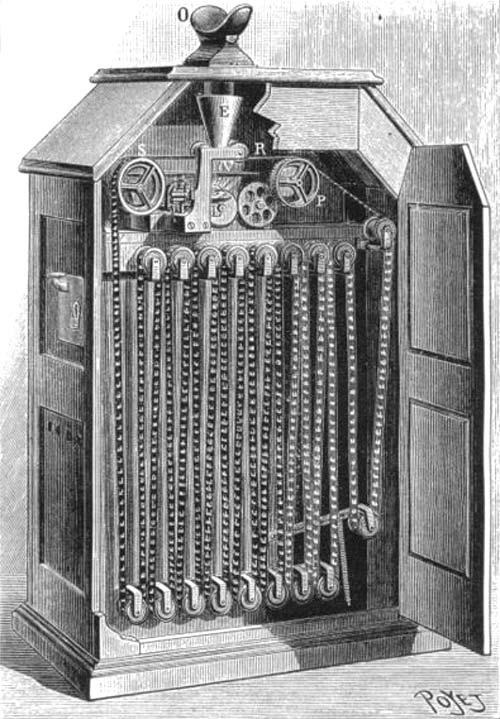
A kinetoscope is a device which allows people to view motion pictures. The kinetoscope was one of the first such devices widely developed and distributed, and while the design ultimately proved to be a failure, it clearly inspired other inventors, so it could be considered a landmark invention in the history of film. This device was invented in the laboratory of Thomas Edison, and as was conventional for inventions in his lab, the patent was taken out by Edison himself, making it challenging to determine precisely who worked on the project. The design for the kinetoscope consisted of a closed cabinet in which the film was spooled. To operate the device, the user opened the top and peered through a small hole, and as the film was moved across a series of rollers, a backlight would illuminate it, creating the illusion of a moving picture, as long as the film was rotated at the proper speed. When the kinetoscope was first shown to the public in 1894, it proved to be a big hit.
Kinetoscopes began to spring up all over the United States, commonly being found in kinetoscope parlours which featured a row of the devices which users could operate by inserting coins into slots. In addition to short films, the kinetoscope was also used to display footage of things like sports matches, allowing people all over the United States to see events which they had not been able to attend. A version of the kinetoscope accompanied with sound was also developed, and christened the kinetophone. Linking sound with pictures turned out to be quite a challenge, as it was extremely difficult to synchronise the sound and the picture. For viewers, the kinetophone was also not terribly comfortable or convenient to use, as it required wearing headphones while leaning over the cabinet to view the movie as it was displayed.
 The phenakistoscope (also spelled phenakistiscope or phe
Phenaksitoscope
The phenakistoscope (also spelled phenakistiscope or phe
The phenakistoscope used a spinning disc attached vertically to a handle. Arrayed around the disc's center were a series of drawings showing phases of the animation, and cut through it were a series of equally spaced radial slits. The user would spin the disc and look through the moving slits at the disc's reflection in a mirror. The scanning of the slits across the reflected images kept them from simply blurring together, so that the user would see a rapid succession of images that appeared to be a single moving picture.
A variant of it had two discs, one with slits and one with pictures; this was slightly more unwieldy but needed no mirror. Unlike the zoetrope and its successors, the phenakistoscope could only practically be used by one person at a time.
How to make a simple phenakistoscope

No comments:
Post a Comment