Wednesday, 10 September 2014
Unit 33 - Assignment 1 Worksheet
https://drive.google.com/file/d/0B6JA5LhpaCCfX2hiSDBsZGdnZUU/edit?usp=sharing

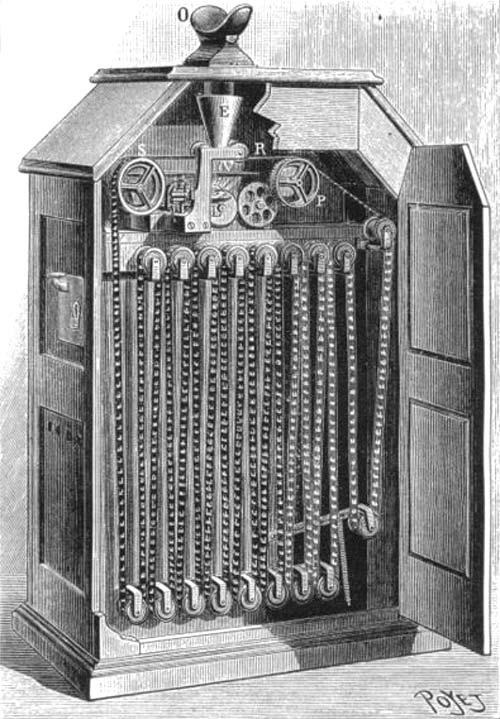
Kinetoscope

A kinetoscope is a device which allows people to view motion pictures. The kinetoscope was one of the first such devices widely developed and distributed, and while the design ultimately proved to be a failure, it clearly inspired other inventors, so it could be considered a landmark invention in the history of film. This device was invented in the laboratory of Thomas Edison, and as was conventional for inventions in his lab, the patent was taken out by Edison himself, making it challenging to determine precisely who worked on the project. The design for the kinetoscope consisted of a closed cabinet in which the film was spooled. To operate the device, the user opened the top and peered through a small hole, and as the film was moved across a series of rollers, a backlight would illuminate it, creating the illusion of a moving picture, as long as the film was rotated at the proper speed. When the kinetoscope was first shown to the public in 1894, it proved to be a big hit.
A kinetoscope is a device which allows people to view motion pictures. The kinetoscope was one of the first such devices widely developed and distributed, and while the design ultimately proved to be a failure, it clearly inspired other inventors, so it could be considered a landmark invention in the history of film. This device was invented in the laboratory of Thomas Edison, and as was conventional for inventions in his lab, the patent was taken out by Edison himself, making it challenging to determine precisely who worked on the project. The design for the kinetoscope consisted of a closed cabinet in which the film was spooled. To operate the device, the user opened the top and peered through a small hole, and as the film was moved across a series of rollers, a backlight would illuminate it, creating the illusion of a moving picture, as long as the film was rotated at the proper speed. When the kinetoscope was first shown to the public in 1894, it proved to be a big hit.
Kinetoscopes began to spring up all over the United States, commonly being found in kinetoscope parlours which featured a row of the devices which users could operate by inserting coins into slots. In addition to short films, the kinetoscope was also used to display footage of things like sports matches, allowing people all over the United States to see events which they had not been able to attend. A version of the kinetoscope accompanied with sound was also developed, and christened the kinetophone. Linking sound with pictures turned out to be quite a challenge, as it was extremely difficult to synchronise the sound and the picture. For viewers, the kinetophone was also not terribly comfortable or convenient to use, as it required wearing headphones while leaning over the cabinet to view the movie as it was displayed.
 The phenakistoscope (also spelled phenakistiscope or phe
Phenaksitoscope
The phenakistoscope (also spelled phenakistiscope or phe
The phenakistoscope used a spinning disc attached vertically to a handle. Arrayed around the disc's center were a series of drawings showing phases of the animation, and cut through it were a series of equally spaced radial slits. The user would spin the disc and look through the moving slits at the disc's reflection in a mirror. The scanning of the slits across the reflected images kept them from simply blurring together, so that the user would see a rapid succession of images that appeared to be a single moving picture.
A variant of it had two discs, one with slits and one with pictures; this was slightly more unwieldy but needed no mirror. Unlike the zoetrope and its successors, the phenakistoscope could only practically be used by one person at a time.
How to make a simple phenakistoscope
Friday, 5 September 2014
Lesson Notes - Assignment 1 (Merit)
What genre is the animation and what generic conventions (things you expect to see) can you pull out?
The genre of the animation is action/crime, we know this by the use of the props, such as guns and knifes. The generic conventions of the animation consist of the use of loud explosions and gun shots. The use of blood and make up tells us its also a action animation. The ending is very generic, with the Villain dying which is a common factor throughout films etc.
What do you notice about the movement of the figures body?
The walking of the characters was unnatural in a funny shuffling manor. It breaks the principals of animation because usually one leg goes infront of the other. but Lee Hardcastle has defied that. When the characters are shot they fly backwards, and uses the effect of gravity to his advantage, he also does this at the end where the villain falls out of he building. This is to make it realistic.
What do you notice about the movement of the figures face and facial expression?
There's a scene where the cats are sweating, this shows fear and alerts the audience that there is danger for the cats, also the sweat falls which also supports the use of gravity and that makes it realistic.
What comments can you make about the use of sound?
Lee Hardcastle uses a rich pallet of sound, by using sounds for the stabbing and the guns, so sound to support the props. Also he uses a non-diagetic soundtrack + dialogue is also used when the cat screamed
What different styles of stop motion have we seen?
We've looked at numerous styles of stop motion. These include, 2D Animation, with the overdrive animation. Claymation, where we watched the Lee Hardcastle Claycats. and paper animation.
What two principals of animation have we looked about?
The two principals of animation are arcs and gravity, to keep realism throughout the animation
When defining 'Overdrive' what word did we use?
Surreal.
Whats the final deadline for the assignment?
19th September
What differences can you see in the two animations?
The movement between the two animations is different, the King kong fight scene is much more jerky and stutters allot. Where as the creature comforts animation has a nice on going smooth flow. Also the sound for the king kong scene cuts off and is looped and you can tell its not very realistic.
What similarities are there in the two animations?
The two similarities of the animations are they're both animal based, also, the camera shot of the animations are more or less the same as eachother all the way throughout,
King King (0;59)
Creature comforts (0;27)
Can you tell if over time there has been a development in the skills and techniques of animation?
Yes, you can see a major advance in animation by just looking at 10 seconds of each animation, the king kong has lack of flow and doesnt look like its done by someone young, but for its time it was amazing, but now it really isnt that great. THe set designs and details are much more crisper, clearer and realistic, this means technology and skill desgin has advanced greatly.
Principles of Animation
Time. Time it takes to make the action happen the number of frames you need to move the object. The fewer frames the faster. The more frames, the slower.
Overlap and Follow through, parts of an object that dont all move at the same time, you have to think about where the centre of gravity is and where it will finish.
Arcs and poses, movement doesnt tend to be straight lines, but it follows curves or arcs, to show more natural movement
Secondary action is natural movement of the body, such as arms swinging whilst moving etc.
The craven dale advert is awful for abiding to the principle of animation as we see in this advert at 0;22 when the cow, pirate and man start dancing around the kitchen. The principle of arc is being completely ignored.
The genre of the animation is action/crime, we know this by the use of the props, such as guns and knifes. The generic conventions of the animation consist of the use of loud explosions and gun shots. The use of blood and make up tells us its also a action animation. The ending is very generic, with the Villain dying which is a common factor throughout films etc.
What do you notice about the movement of the figures body?
The walking of the characters was unnatural in a funny shuffling manor. It breaks the principals of animation because usually one leg goes infront of the other. but Lee Hardcastle has defied that. When the characters are shot they fly backwards, and uses the effect of gravity to his advantage, he also does this at the end where the villain falls out of he building. This is to make it realistic.
What do you notice about the movement of the figures face and facial expression?
There's a scene where the cats are sweating, this shows fear and alerts the audience that there is danger for the cats, also the sweat falls which also supports the use of gravity and that makes it realistic.
What comments can you make about the use of sound?
Lee Hardcastle uses a rich pallet of sound, by using sounds for the stabbing and the guns, so sound to support the props. Also he uses a non-diagetic soundtrack + dialogue is also used when the cat screamed
What different styles of stop motion have we seen?
We've looked at numerous styles of stop motion. These include, 2D Animation, with the overdrive animation. Claymation, where we watched the Lee Hardcastle Claycats. and paper animation.
What two principals of animation have we looked about?
The two principals of animation are arcs and gravity, to keep realism throughout the animation
When defining 'Overdrive' what word did we use?
Surreal.
Whats the final deadline for the assignment?
19th September
What differences can you see in the two animations?
The movement between the two animations is different, the King kong fight scene is much more jerky and stutters allot. Where as the creature comforts animation has a nice on going smooth flow. Also the sound for the king kong scene cuts off and is looped and you can tell its not very realistic.
What similarities are there in the two animations?
The two similarities of the animations are they're both animal based, also, the camera shot of the animations are more or less the same as eachother all the way throughout,
King King (0;59)
Creature comforts (0;27)
Can you tell if over time there has been a development in the skills and techniques of animation?
Yes, you can see a major advance in animation by just looking at 10 seconds of each animation, the king kong has lack of flow and doesnt look like its done by someone young, but for its time it was amazing, but now it really isnt that great. THe set designs and details are much more crisper, clearer and realistic, this means technology and skill desgin has advanced greatly.
Principles of Animation
Time. Time it takes to make the action happen the number of frames you need to move the object. The fewer frames the faster. The more frames, the slower.
Overlap and Follow through, parts of an object that dont all move at the same time, you have to think about where the centre of gravity is and where it will finish.
Arcs and poses, movement doesnt tend to be straight lines, but it follows curves or arcs, to show more natural movement
Secondary action is natural movement of the body, such as arms swinging whilst moving etc.
The craven dale advert is awful for abiding to the principle of animation as we see in this advert at 0;22 when the cow, pirate and man start dancing around the kitchen. The principle of arc is being completely ignored.
Thursday, 4 September 2014
Tuesday, 12 August 2014
VIDEO TECHNOLOGY AND EDITING TECHNIQUES
What is High definition in TV And Film

High definition TV is a sharper, clearer and gives a more realistic and life like feel to standard definition TV. This is due to higher resolution which means more information is added thats available to create the picture.
Common types of High definition are 720p which is also known as "HD Ready". This is a little bit more than double of standard defintion and 1080p which can also be recognized as "Full HD" which has more than 5 times as much picture information. if you want the best possible quality then 1080p is what you would look for.
SKIP TO 2;29 FOR SIDE BY SIDE COMPARISON OF STANDARD TV AND HD TV:
https://www.youtube.com/watch?v=HSgmNgQrlQw
What are the different aspect ratios for TV and film?
Which ones are better for TV progs and films?
Aspect Ratio is basically the proportion of the height and width of what image is being shown, in TV and Film 16:9 is the most common ratio used for high definition television as well as movies. 49:9 is a compromised aspect ratio tgat can be used to create a picture acceptable to 16:9 and 4:3 TVs.

What are the different types of audio and video signals?
An audio file format is the file that is used to store digital audio on a computer. the layout of the audio in the data is called Audio coding format. It can be uncompressed or compressed to make the overall file size smaller. There are quite a few different formats of audio
PCM - Also known as Pulse code modulation is the most used form of storing analog signals in a digital format. CD date is stored as PCM as are most file formats that are used in digital downloads.
AAC - Known as Advanced Audio Coding or more commonly recognised as Mp4 with advanced audio coding. AAC is a lossy compressed file format created to be the successor to mp3 and site such as iTunes store for its music downloads and youtube when it streams audio.
Mp3 - The most popular and most used lossy compressed file format which became an MPEG standard in 1993.
WMA - Windows Media Audio is Windows proprietary codec and comes in a lossy compressed version as well as a lossless compressed version.
WAV - waveform audio file which is another mainstream uncompressed format for music downloads developed by microsoft and IBM. One major fault of WAV is its lack of widespread support
Video Signal
RGB - RGB which is otherwise known as Reg Green and Blue is the most native format for computer graphics and video files. the signal is used inside traditional colour CRTs, Flat panel displays and video projectors. the RBG colours are merged and combined to recreate any possible colour, as well as grayscale images stretching from black to white.
S-Vid - An S video signal is also seen as a component video signal because the luma and chroma signals are seperated, however the C signal is derived by combining the CB and CR signal which lowers the quality of the colour channel abit.
Composite - The Luma and Chroma signals are mixed into a singal composite video signal for broadcast. the chroma signal is placed on a colour side frequency linked to the main luma frequency.
Storage - Digital footage is stored on hard disks or flash memory because its cheap, reliable and easy to transport as apose to a film reel.
Digital Filming - The process of capturing images digitally as apose to the historical use of film reels, film reels are seen as a negative. Allot of hollywood movies are shot digitally. Allot of hollywood films are also filmed on film reels still. Digital filming is shifting towards tapeless or file based work flows this trend has accelerated with increased capacity and low cost technology.
Terrestrial TV - Terrestrial television is a type of television broadcasting in which thetelevision signal is transmitted by radio waves to the TV receiver from aterrestrial (Earth based) transmitter, a television station, and received with an antenna.
Storage - Digital footage is stored on hard disks or flash memory because its cheap, reliable and easy to transport as apose to a film reel.
Digital Filming - The process of capturing images digitally as apose to the historical use of film reels, film reels are seen as a negative. Allot of hollywood movies are shot digitally. Allot of hollywood films are also filmed on film reels still. Digital filming is shifting towards tapeless or file based work flows this trend has accelerated with increased capacity and low cost technology.
Terrestrial TV - Terrestrial television is a type of television broadcasting in which thetelevision signal is transmitted by radio waves to the TV receiver from aterrestrial (Earth based) transmitter, a television station, and received with an antenna.
Recording TV - TV used to be recorded on blank tapes purchasable from pretty much anywhere and you would put it in your box and it would record onto the tape. However tech has progressed and now you can simply record it through Sky and Virgin, and other TV services which will allow you to record straight from your TV and be stored on a cloud.
Editing Software:
- Adobe Premier
- Sony Vegas
- Final Cut Pro


HD or SD? - "In a nutshell, the difference between high definition and standard definition images is the number of pixels contained in the image on display. HD images have more pixels per square inch than standard definition videos. Okay fine, but what does that really mean?
It means that HD images can show much finer detail than SD images. Here’s a simple analogy that should explain why.
Imagine you have a 3×5″ card, and you’ve been asked to draw a picture of a flower on it. You’re given your choice of two drawing tools: either a preschooler-type crayon (the really big ones) or a finely sharpened pencil. If you choose the crayon, your picture can’t possibly include as much detail as you could provide with the pencil drawing, because the crayon draws a much thicker line and you’re limited to the size of a 3×5″ card. And that’s just like the difference between SD and HD: the HD image shows finer detail because it “draws” the image with smaller, and more, pixels than an SD image can."
Thursday, 3 July 2014

Subscribe to:
Posts (Atom)